How to Set Your Freelance Rate: The Math Most Freelancers Skip
Dividing your old salary by 2,080 hours is how freelancers accidentally take a pay cut. Here is the actual math — unbillable time, self-employment taxes, expenses, and gaps — and a calculator that runs it for you, privately.
In this article
Ask a new freelancer how they picked their rate and you will usually hear one of two answers: "I took my old salary and divided by 2,080 hours," or "I looked at what other people charge." Both feel reasonable. Both quietly guarantee a pay cut — sometimes a severe one — and the reason is arithmetic, not market conditions.
This is the math worth doing once, properly. Our Freelance Rate Calculator runs it live (entirely in your browser — your income goals are nobody's lead-gen data), but you should understand what it is computing and why.
Why salary ÷ 2,080 fails
2,080 is 40 hours × 52 weeks — the arithmetic of an employee's year. The formula smuggles in three assumptions that are false for every freelancer:
Assumption 1: every working hour is billable. It isn't — not close. Freelancing means you are also the sales department, the accountant, the marketer, and the person answering email. Established freelancers with steady clients bill 70–80% of their working time; people in their first year or two often bill 50% or less. Proposals, discovery calls, invoicing, portfolio updates, learning new tools — all real work, none of it invoiced.
Assumption 2: someone else pays the overhead. Employees never see the costs their employer absorbs: software licenses, hardware, insurance, accounting, the office. Freelancers see all of it. A modest solo practice runs $5,000–$15,000 a year in genuine business expenses before a dollar reaches you.
Assumption 3: taxes work the same way. They don't. In most countries the self-employed pay both halves of social-security-style contributions, on top of income tax — and fund their own health coverage, retirement matching, and paid leave. A freelancer's effective rate on profit routinely lands in the 25–35% range before any of those self-funded benefits.
Stack the three together and the honest conversion is stark: matching a $90,000 salary typically requires charging $110–130 per hour, not the $43 that salary ÷ 2,080 produces.
The formula, in the open
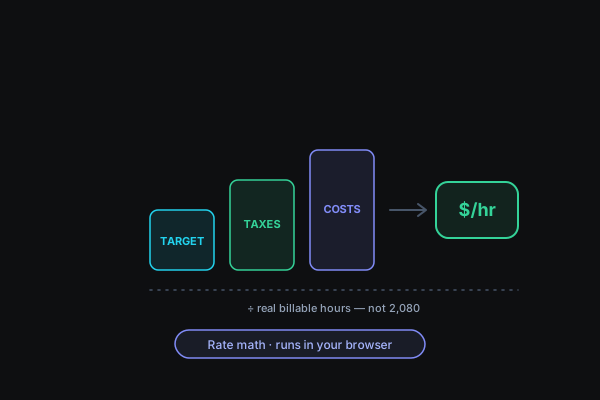
The calculation the calculator runs is four steps, and each one is legible:
- Gross revenue needed = target take-home ÷ (1 − tax rate) + annual expenses. Taxes come off your profit, so the target has to be grossed up first.
- Working weeks = 52 − weeks off. Vacation, public holidays, sick days — and, uniquely for freelancers, the gaps between projects. Six weeks total is a conservative, realistic figure.
- Billable hours per year = hours per week × billable share × working weeks. This is the number that shocks people: 40 hours at a healthy 60% billable across 46 weeks is 1,104 hours — barely half of 2,080.
- Hourly rate = revenue needed ÷ billable hours.
Run your own numbers in the calculator and open "Show math" — the same four lines, with your figures in them. If the result makes you flinch, that is the point: the flinch is the gap between employee arithmetic and business arithmetic.
From hourly rate to actual pricing
The hourly figure is a floor, not a menu. Three ways to use it:
- Day rates: multiply by 6–8 hours depending on how much genuinely focused delivery a day of consulting contains. Day rates also gently discourage the death-by-fifteen-minute-tasks engagement pattern.
- Project pricing: estimate the hours honestly, multiply by your rate, then add a buffer for the revision cycle you know is coming. If a client's budget is below the result, the scope shrinks — the rate doesn't.
- Value pricing: for work with measurable client upside, price against the outcome instead of the hours. The hourly floor still matters: it tells you when a "great opportunity" is actually below your minimum.
Pro tipRevisit the numbers annually — or immediately when something structural changes: your billable share improves, your expenses jump, or you decide to work a four-day week. The rate that was right at 50% billable is wrong at 75%.
The uncomfortable comparison table
When you are deciding between a salaried offer and staying independent, run both through the same lens. The salary number includes invisible compensation — employer tax contributions, insurance, paid leave, retirement match, equipment — that typically adds 25–40% on top of the stated figure. Comparing a $90k salary to $90k of freelance revenue is comparing apples to a photograph of apples. The Salary Calculator handles the employee side of that comparison; the rate calculator handles the freelance side.
Common objections, answered honestly
"Nobody in my market pays that." Sometimes true — and useful information. If the market rate for your work cannot support your income target at realistic billable hours, the math is telling you to change the work (specialize, move upmarket) or change the target, not to quietly absorb the gap and discover it at tax time.
"I'll charge less to win clients, then raise rates." Raising rates on existing clients is one of the hardest conversations in freelancing, and anchoring low attracts exactly the clients most resistant to it. Discounting a first project is cleaner than discounting your rate.
"My competitor charges half of this." Either they have done this math and have structurally lower costs — or they haven't done it, and they are subsidizing their clients out of their own retirement. You are not competing with the second group; you are watching them exit the industry in slow motion.
A worked example, start to finish
Maya is a designer leaving a $85,000 job. Her numbers: she wants to match her old take-home ambition at $85,000, expects $9,000 in annual business costs (software, insurance, a coworking desk, an accountant), estimates 30% combined tax on profit, plans a 40-hour week at a realistic 55% billable share while she builds a client base, and budgets 7 weeks unworked across vacation, holidays, and project gaps.
The four steps: revenue needed is 85,000 ÷ 0.70 + 9,000 = $130,429. Working weeks: 52 − 7 = 45. Billable hours: 40 × 0.55 × 45 = 990 hours. Rate: 130,429 ÷ 990 = $132/hour, or roughly a $1,050 day rate.
Compare that to her salary ÷ 2,080 instinct of $41/hour: the honest rate is more than three times higher. If Maya had opened with $65/hour because it "felt like a lot more than her old wage," she would have been building a business that pays her roughly half her old job — with none of the benefits. That is the entire case for doing this arithmetic before the first client call, not after the first tax bill.
None of your inputs to any of this — income targets, expenses, tax situation — leave your device. That is how every calculator on this site works, and we verify it publicly rather than asking you to take it on faith.